


Thermal Validation & Mapping: Ensuring Climate Stability in Critical Storage Environments
Thermal Validation & Mapping is the systematic process of documenting that a temperature-controlled environment—such as refrigerators, freezers, incubators, or warehouses—maintains a uniform, stable climate suitable for storing sensitive biological materials, pharmaceuticals, and research samples.
In the UAE, where ambient temperatures can exceed 45°C, thermal mapping is essential to prove that your cooling systems effectively manage external heat loads, safeguarding valuable products and ensuring regulatory compliance.
Critical Environments for Thermal Mapping
To comply with MOHAP and WHO guidelines, thermal mapping is performed in:
Ultra-Low Freezers (-80°C): For long-term storage of vaccines, genomic samples, and critical biologics.
Cold Rooms & Refrigerators (2°C to 8°C): Standard storage for insulin, biologics, and clinical reagents.
Incubators (37°C): Ensuring consistent temperature for microbiology cultures and cell growth.
Stability Chambers: Used for accelerated shelf-life testing of drug formulations.
Warehouses: Identifying “hot spots” and “cold spots” near loading docks, HVAC vents, and doors.
The Thermal Validation Process (IQ/OQ/PQ)
Sensor Placement:
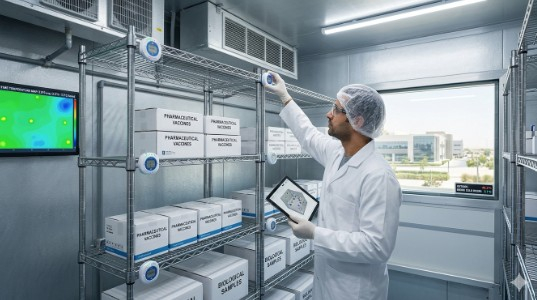
High-accuracy, NIST-calibrated data loggers are strategically placed in a 3D grid throughout the environment, including corners, near doors, and close to cooling units.
Duration:
Typically ranges from 24 to 72 hours for small units, extending up to 7 days for large warehouses or complex storage areas.
Stress Tests:
Open Door Test: Measures temperature rise when the door is held open for a typical period.
Recovery Test: Measures the time required for the environment to return to the setpoint after door closure.
Power Failure Test: Determines the “hold time” before temperatures reach critical thresholds during power outages.
UAE Regulatory Compliance
ISO/IEC 17025: Calibration laboratories providing thermal mapping services in the UAE must be accredited to ensure data validity and traceability.
WHO Technical Report Series (TRS 961): The international benchmark for storage and transport conditions of temperature-sensitive products.
The 45°C Challenge: Why Thermal Mapping is Your Lab’s Invisible Shield
In the UAE’s harsh climate, your cooling systems face intense external pressures. Thermal mapping goes beyond a single temperature probe, providing a full-scale diagnostic of temperature distribution across your storage environment.
Risk of Single-Point Monitoring:
A lone temperature sensor only captures conditions in one location, risking undetected “hot spots” near doors or “freeze zones” near cooling fans that can compromise samples.
Cold Chain Integrity:
For pharmaceutical distributors and hospitals, MOHAP audits require documented evidence of temperature stability. Thermal mapping offers data-backed assurance that your cold chain remains intact—even during Dubai summers or unexpected power interruptions.
When to Remap
Routine thermal mapping is recommended annually. Additionally, re-validation is necessary if:
Significant HVAC or refrigeration repairs have been made.
The loading or storage pattern within the unit changes substantially.
The equipment has been relocated or replaced.