


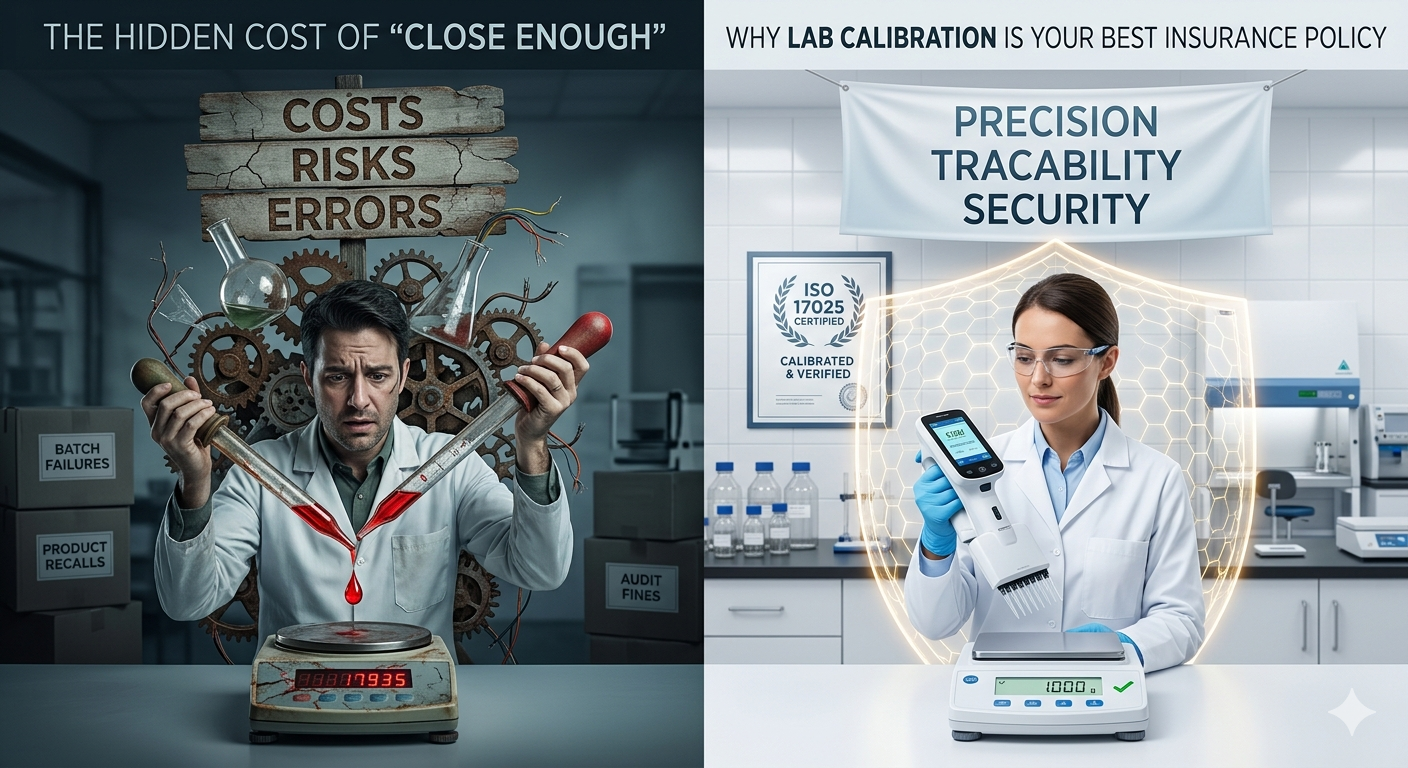
The Hidden Cost of "Close Enough": Why Lab Calibration is Your Best Insurance Policy
In a high-precision laboratory, "almost accurate" is the same as "wrong." Whether you are measuring out a potent pharmaceutical compound or testing a patient’s blood sample, the reliability of your data rests entirely on one thing: Calibration.
In the UAE’s rapidly growing biotech and healthcare sectors, following ISO/IEC 17025 and ENAS/EIAC standards isn't just a hurdle to jump—it’s the foundation of your laboratory’s reputation.
Why Calibration Drifts (and Why You Can’t Ignore It)
No matter how expensive your equipment is, accuracy "drifts" over time. Wear and tear on mechanical parts, environmental factors like the UAE’s humidity, and even simple repeated use can cause your instruments to provide misleading data.
- Pipettes: A slight seal leak can lead to under-pipetting, ruining an entire batch of PCR tests.
- Balances: Dust or mechanical fatigue can cause micro-variations that lead to incorrect formulations.
- Incubators: A shift of just 1°C can be the difference between a successful culture and a failed experiment.
The Checklist: 4 Signs You Need Immediate Calibration
While most labs stick to an annual or bi-annual schedule, you should call an accredited technician immediately if:
- The "Drop" Factor: An instrument was dropped or physically jarred.
- Environmental Shocks: There was a significant failure in the lab’s HVAC or power systems.
- The "Outlier" Result: Your control samples are consistently yielding unexpected data.
- Major Maintenance: You’ve recently replaced a motor, a heating element, or a sensor.