



Particle Count Testing for Cleanroom Air Quality Validation
Particle Count Testing is the primary method to validate and monitor airborne particulate cleanliness within cleanrooms, aligned with the stringent requirements of ISO 14644-1. This test uses a calibrated discrete particle counter to measure airborne particle concentrations at critical sizes—typically (0.1,\mu m), (0.5,\mu m), and (5.0,\mu m)—to ensure compliance with cleanroom classification standards.
In the UAE, specialized accredited laboratories such as URS Labs and Arabcal offer professional particle counting services to help facilities meet MOHAP (Ministry of Health and Prevention) and EIAC (Emirates International Accreditation Centre) regulatory standards.
ISO 14644-1 Cleanroom Classifications (At Rest)
ISO Class (\geq 0.1,\mu m) (\geq 0.5,\mu m) (\geq 5.0,\mu m) Typical Applications
ISO 5 100,000 3,520 20 Aseptic Filling, Sterile Compounding (Grade A)
ISO 6 1,000,000 35,200 293 Medical Device Manufacturing
ISO 7 Not Required 352,000 2,930 Electronics Assembly, Pharmacy Ante-rooms
ISO 8 Not Required 3,520,000 29,300 General Support Zones, Gowning Areas
Routine vs. Emergency Monitoring
Routine Monitoring:
Conducted at scheduled intervals—typically every 6 months for ISO 5 and cleaner, and annually for ISO 6 and above—to document that the cleanroom remains in a validated state.
Emergency Monitoring:
Triggered immediately after suspected contamination events such as HVAC failure, spills, or breaches in airlocks to assess impact and guide corrective actions.
Testing Methodology
Sampling Plan:
Determined based on the cleanroom size and layout, defining the number and location of sampling points per ISO 14644-2.
Instrument Calibration:
Particle counters are calibrated according to ISO 21501-4 standards using NIST-traceable reference particles to ensure data accuracy.
States of Occupancy:
Testing is performed in both:
At-Rest: Equipment running, no personnel present.
Operational: During active work to understand the effect of personnel and processes on air quality.
Why Particle Count Testing Matters: Insights for UAE Facilities
The Invisible Warning Light:
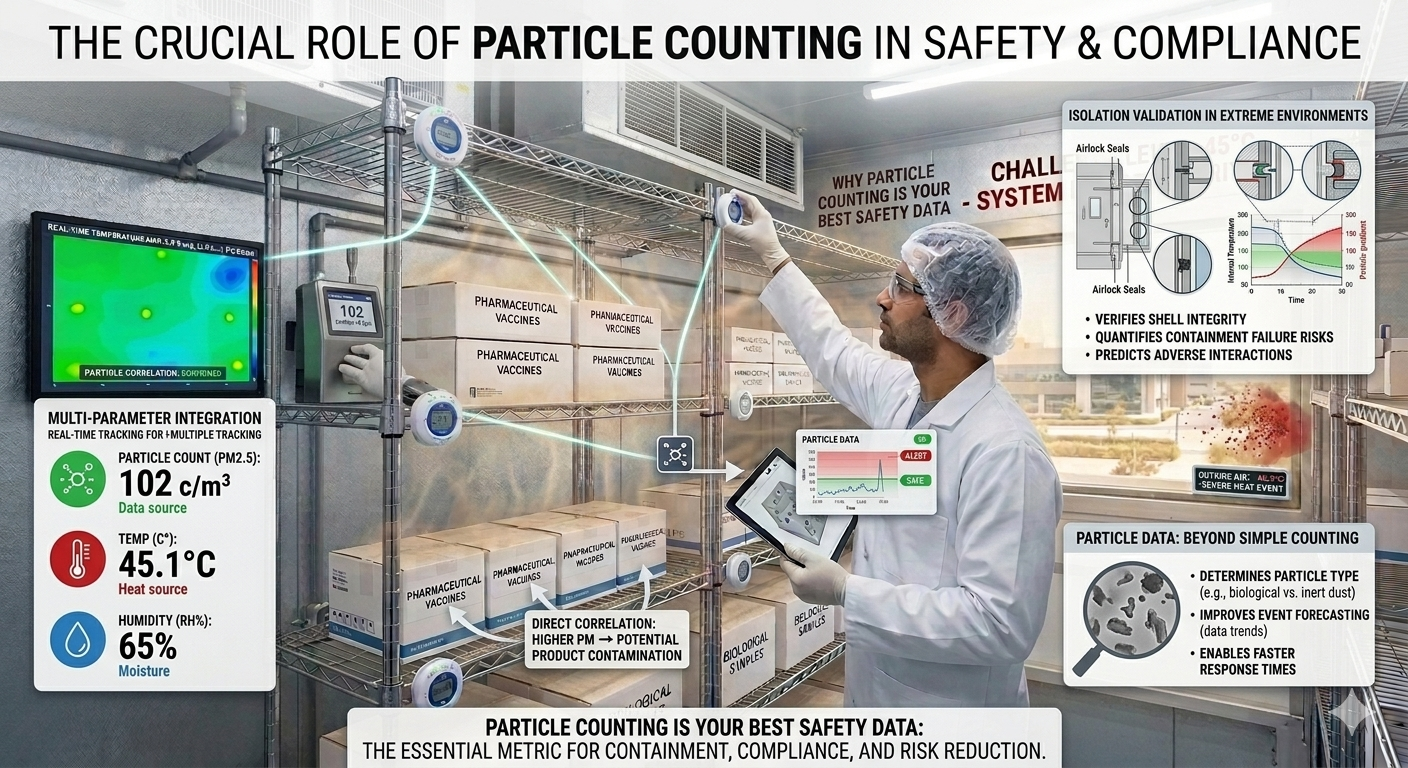
Particle count testing acts as an early detection system. Even minor filter failures or compromised gowning can be detected before causing costly contamination or product rejection.
UAE Environmental Challenges:
With pervasive external dust and sand, maintaining cleanroom air quality is especially challenging. Routine particle count testing ensures HVAC systems effectively filter out these airborne contaminants.
Real-Time Accountability:
Modern monitoring systems provide continuous data, enabling facility managers to correlate particle spikes with specific activities (e.g., door openings, shift changes) and implement targeted procedural improvements.
Audit-Ready Compliance:
The 2015 ISO 14644 update imposes stringent requirements on sampling and reporting. Partnering with accredited UAE labs ensures your documentation meets both national and international regulatory expectations.