


Airflow Visualization (Smoke Testing) for Cleanrooms and Biosafety Cabinets
Purpose:
Airflow visualization, commonly known as smoke testing, is a diagnostic technique used to visually confirm proper air movement within controlled environments such as cleanrooms and Biosafety Cabinets (BSCs). This test ensures the airflow protects sterile products by maintaining laminar (unidirectional) flow and, in BSCs, contains hazardous materials to safeguard personnel.
Core Testing Objectives
Verify Laminar (Unidirectional) Flow:
Confirm HEPA-filtered air moves smoothly in a single direction—either vertically or horizontally—without swirling, reversing, or mixing.
Identify Turbulence and Dead Zones:
Detect areas where airflow stagnates or vortices form, which can harbor contaminants and compromise cleanliness.
Assess Containment:
Ensure that “first air” (clean air directly from HEPA filters) reaches critical zones and that no air escapes or infiltrates through leaks (e.g., window seals, front sashes).
Observe Dynamic Conditions:
Evaluate how operator movements, equipment placement, and interventions (such as opening pass-throughs) impact airflow patterns.
Regulatory Standards
ISO 14644-3:
The global standard specifying cleanroom test methods, including airflow direction and uniformity evaluation.
EU GMP Annex 1:
Requires “in situ” air pattern analysis in Grade A zones under both “at-rest” and operational conditions.
NSF/ANSI 49:
The primary certification standard for Class II Biosafety Cabinets mandates smoke pattern testing.
USP <797>:
Calls for dynamic smoke testing every six months in sterile compounding facilities to verify primary engineering controls.
Acceptance Criteria
Feature Cleanroom (Grade A / ISO 5) Biosafety Cabinet (Class II)
Flow Pattern Smooth vertical downward flow lines Downflow air splits at work surface toward front/back grilles
Containment No upward/lateral entrainment toward sterile items Total containment at front opening; no smoke escape
Recovery Any turbulence rapidly cleared away Smoke drawn in at front without reflux or billowing
Zones No stagnant “dead spots” behind equipment Continuous inward airflow across access opening perimeter
Test Methodology & Tools
Tracers:
Neutrally buoyant smoke generators (glycol-based fog, nebulized deionized water, ultrasonic misters) produce visible smoke that follows air currents without drifting due to its own weight.
Documentation:
High-resolution video recordings from multiple angles provide compelling evidence for regulatory audits.
Execution States:
Tests are performed in three states:
As-Built: Empty room or cabinet
At-Rest: Equipment installed, no personnel present
Operational: Active simulation with personnel and equipment in use
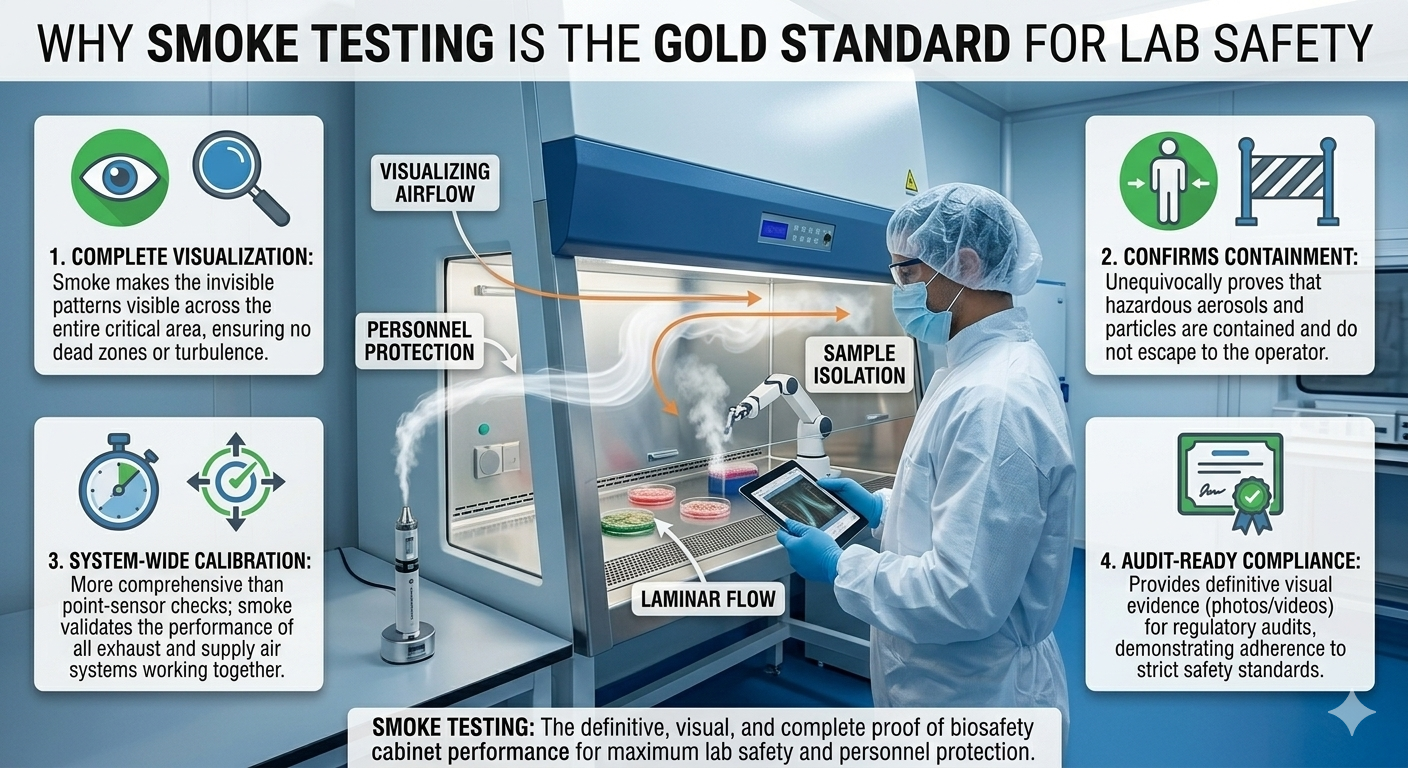
Why Smoke Testing is the Gold Standard for Lab Safety
Airflow is invisible, yet it forms the critical barrier protecting sterile products and personnel. Sensors and monitors provide data, but only smoke testing makes the airflow visible, proving your ventilation system performs as designed.
Laminar vs. Chaos:
Laminar flow ensures clean air moves steadily to critical zones without disruption. Turbulence or dead zones trap contaminants, jeopardizing sterility.
Cleanrooms:
Smoke testing ensures “first air” reaches sterile products unobstructed by equipment or personnel.
Biosafety Cabinets:
Demonstrates containment by confirming no air escapes or billows from the front sash, protecting the operator.
Operational Testing:
Validates that daily activities—arm movement, door openings, equipment operation—do not compromise airflow patterns, as required by EU GMP Annex 1 and USP <797>.
The UAE Context
In the UAE, HVAC systems battle extreme outdoor heat and humidity, which can shift internal air balance. Regular smoke testing—at least every six months as per USP <797>—is vital to confirm that your cleanroom or BSC airflow remains stable and compliant, preventing costly contamination or audit failures.