


HEPA Filter Integrity Test (Leak Test / DOP/PAO Test)
Purpose:
The HEPA Filter Integrity Test is a critical on-site procedure designed to verify that installed HEPA filters are free from defects such as pinhole leaks in the filter media or gaps in the housing and seals. While manufacturers certify filter efficiency under controlled factory conditions, integrity testing performed in situ ensures the filter remains uncompromised through shipping, handling, and installation.
Key Testing Standards & Pass Criteria
Allowable Leakage:
According to ISO 14644-3 and NSF/ANSI 49, a filter leak is defined as any localized penetration exceeding 0.01% of the upstream aerosol challenge concentration.
ISO 14644-3:
The primary international standard governing cleanroom validation and HEPA filter leak testing.
NSF/ANSI 49:
The definitive standard for Biosafety Cabinets, mandating the aerosol photometer method for leak detection and strictly prohibiting particle counters for this purpose, due to reliability concerns.
The Aerosol Photometer Test Procedure
Upstream Challenge:
A known concentration of aerosolized particles, commonly Polyalphaolefin (PAO)—a safe replacement for the older Dioctyl Phthalate (DOP)—is introduced upstream of the filter.
Calibration:
The photometer measures the upstream concentration to establish a 100% baseline for comparison.
Downstream Scanning:
A qualified technician uses a photometer probe to scan the entire face of the filter, including the filter media, frame, and seals. The scan is performed approximately 1 inch from the surface at a steady pace (~10 feet per minute).
Leak Detection:
If the photometer detects a concentration exceeding 0.01% of the upstream challenge, the location is marked as a leak site requiring repair or filter replacement.
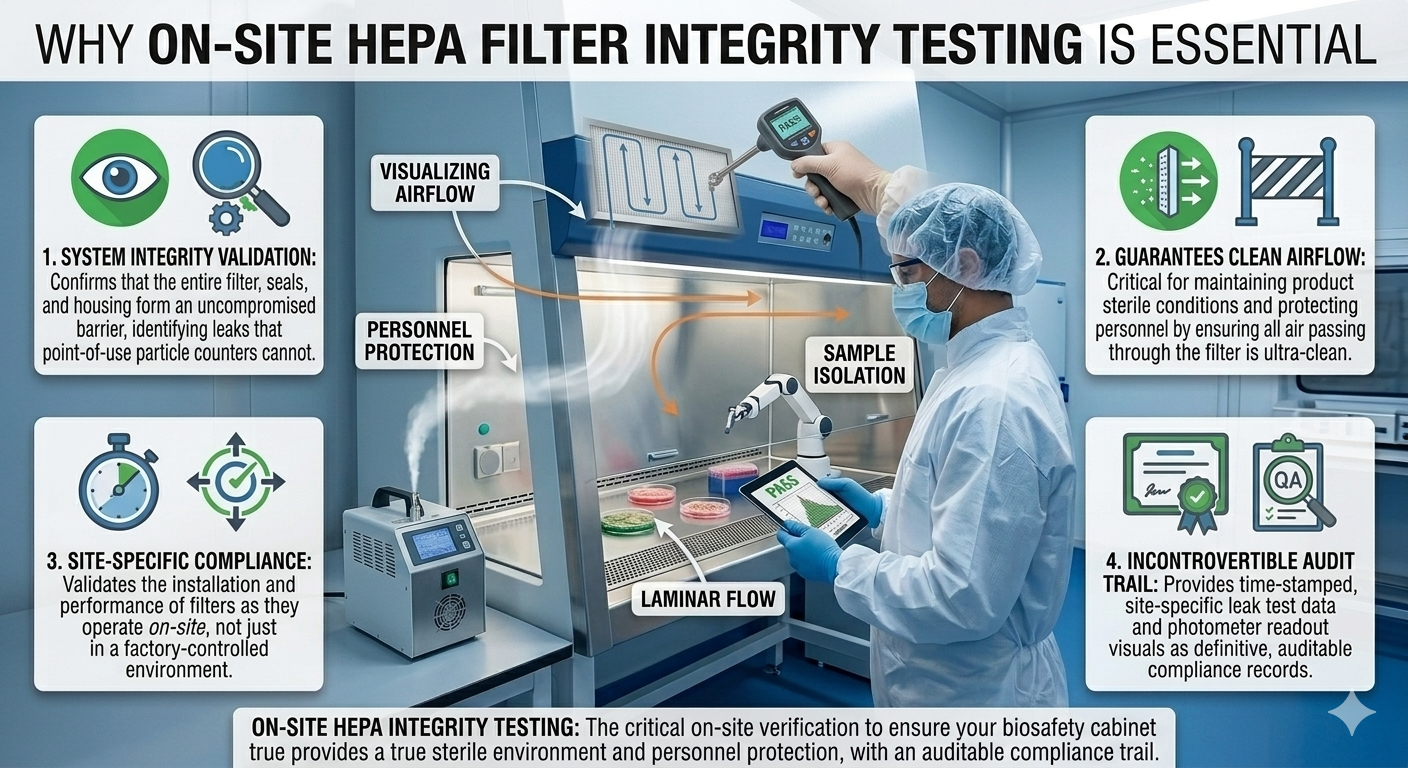
Why On-Site HEPA Filter Integrity Testing is Essential
Despite factory certifications, filters can sustain damage during transportation or installation, creating bypass leaks that compromise cleanroom or biosafety cabinet safety. Even a tiny leak allows hazardous particles to bypass the filter, posing significant contamination risks in sterile or high-containment environments.
Factory Testing vs. In-Situ Testing:
Factory tests confirm the filter media efficiency alone.
In-situ testing validates the entire installed system, including filter media, frame, and gasket seals under operational conditions.
The Strict 0.01% Leakage Threshold
This stringent pass criterion reflects the critical need for near-perfect filtration in environments such as sterile compounding pharmacies, pharmaceutical manufacturing cleanrooms, and BSL-3/4 laboratories. A failure at this level could mean thousands of potentially dangerous particles enter the clean space every minute.
Compliance with Global and UAE Standards
For laboratories and facilities in the UAE, compliance with international standards is mandatory for regulatory approval and operational safety:
ISO 14644-3: Governs cleanroom testing and filter integrity globally.
NSF/ANSI 49: The gold standard for biosafety cabinet certification, requiring photometer-based leak detection for reliable, real-time results.
If you require expert HEPA Filter Integrity Testing services in the UAE, our accredited technicians deliver precise, on-site testing with comprehensive reporting to ensure your cleanrooms and biosafety cabinets meet or exceed all applicable standards and regulatory requirements.