


Pressure Concepts
Absolute Pressure
- Total pressure in the system.
- Formula:
[ Absolute Pressure} = {Gauge Pressure} +Atmospheric Pressure} ]
Absolute Zero Pressure
- Defined as 760 mm Hg vacuum.
Maximum Vacuum
- Maximum vacuum corresponds to 760 mm Hg.
Vacuum
- Any pressure below atmospheric pressure.
Primary Elements for Measuring Pressure
Bourdon Tube
Types:- C-type
- Spiral
- Helix
Diaphragm
- Best suited for low-pressure measurement.
Capsule
- Two circular diaphragms welded together forming a pressure capsule.
- Materials: Phosphor bronze, Ni-Spank stainless steel.
Bellows
- One-piece collapsible metallic unit with deep folds, made from thin-walled tubing.
- Materials: Brass, phosphor bronze, stainless steel.
- Used for high pressure.
Pressure Springs
- Helical or spiral springs used to measure high pressures.
Calibration of Absolute Pressure Transmitter (Range 0-400 mm abs)
- Connect air supply to the transmitter.
- Connect a test gauge (0-1.4 kg/cm²) to the output.
- Connect vacuum pump with a tee to the manometer.
- Apply 760 mm vacuum (absolute zero) and adjust zero.
- Apply 360 mm vacuum and adjust span. (Since (760 - 360 = 400) mm abs.)
Troubleshooting Vacuum Measurement
- Given mercury manometer range 0-760 mm.
- Vacuum gauge reads 60 mm vacuum.
- Transmitter reads 710 mm.
- Test manometer reads 50 mm vacuum.
Which is correct?
- The transmitter is correct because:
[ 760 - 50 = 710 \text{ mm absolute pressure} ]
Inclined Manometer
- Used to extend the scale of the instrument.
- The manometer is inclined with respect to vertical, providing greater resolution for small pressure differences.
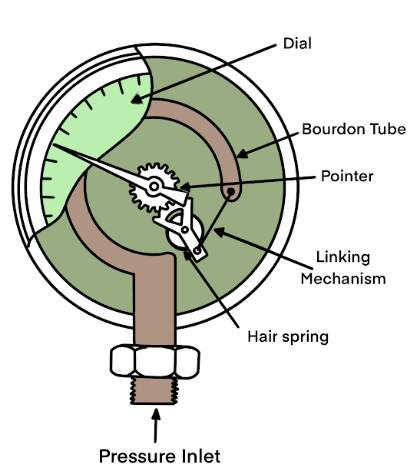
Principle of Pressure Gauge
- Based on Hooke’s Law: Measures the stress (strain) in an elastic medium.
Pressure Gauge Components & Use of Hairspring
Parts:
- C-type Bourdon tube
- Connecting link
- Sector gear
- Pinion gear
- Hairspring
- Pointer
- Dial
Uses of Hairspring:
- Eliminates any play in the linkages.
- Provides controlling torque to the pointer, ensuring accurate reading.